
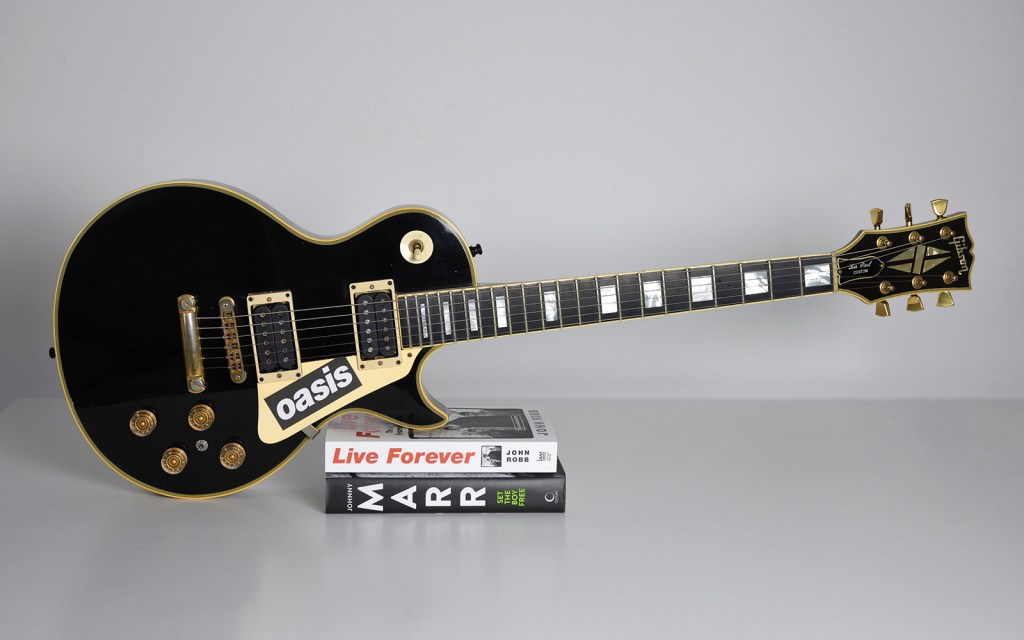
Here’s another one of those geeky deep-dives into guitar pickups. A few months back, I wrote an in-depth piece on the bridge humbucker in the ex-Johnny Marr Gibson Les Paul “conversion”. Now it’s time to look at the magnetic heart of the other legendary Les Paul – the black Custom from 1978.
For decades, this has been a mystery. Over the years, I wondered whether the pickups were uncovered Gibsons, Seymour Duncans, or DiMarzios, but no clear answer ever emerged…
Keep reading after the break!
As you may remember, last year I built a historically accurate replica of the Black Les Paul Custom (detailed in this earlier article). By now, we know a lot about Noel’s (actually Johnny’s) Custom1, but one question has always remained: what pickups did it have?
In the absence of a definitive answer, I went with Seymour Duncans for my replica: a Pearly Gates in the bridge and a Jazz Model in the neck. The Jazz sounded great – even though I rarely use the neck pickup – but I wasn’t completely happy with the Pearly Gates.
I eventually swapped it out for a Saturday Night Special, an Alnico IV humbucker with plenty of dynamics. It was an excellent match to be fair, but I was still chasing the exact bridge pickup that Johnny and Noel had in the original Black Custom.
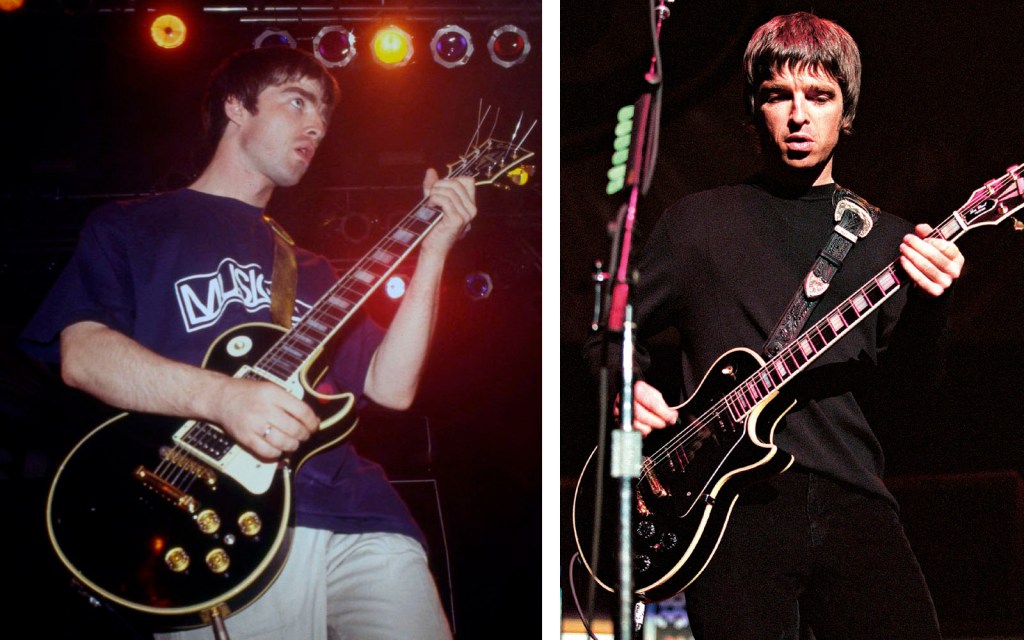
The thing is, as you probably know, Noel modified the Black Custom himself in the summer of 1999. The humbuckers were taken out and replaced with P-90s from his Firebird.
P-90s in a Les Paul? Sounds cool. As it turns out, Noel still loves that combo in 2025…
The only way to figure out what the original pickups were is by looking at old photos: that’s no easy task when most of what we have are grainy pictures and low-quality video footage from the mid ’90s.
As for the reason why Noel swapped them out, his explanations have changed over the years: in 2000 he said they were “really modern pickups” he “didn’t like“,2 but in 2023 he claimed they had simply “got damaged“.3 Maybe he just wanted to drop a set of P-90s into a Les Paul after experimenting with them in various Epiphone Casinos back in 1999.

One photo by Paul Slattery4 seemed to hint at a DiMarzio Super Distortion in the bridge position: the details looked right, but with the poor resolution I couldn’t tell if I was seeing things.
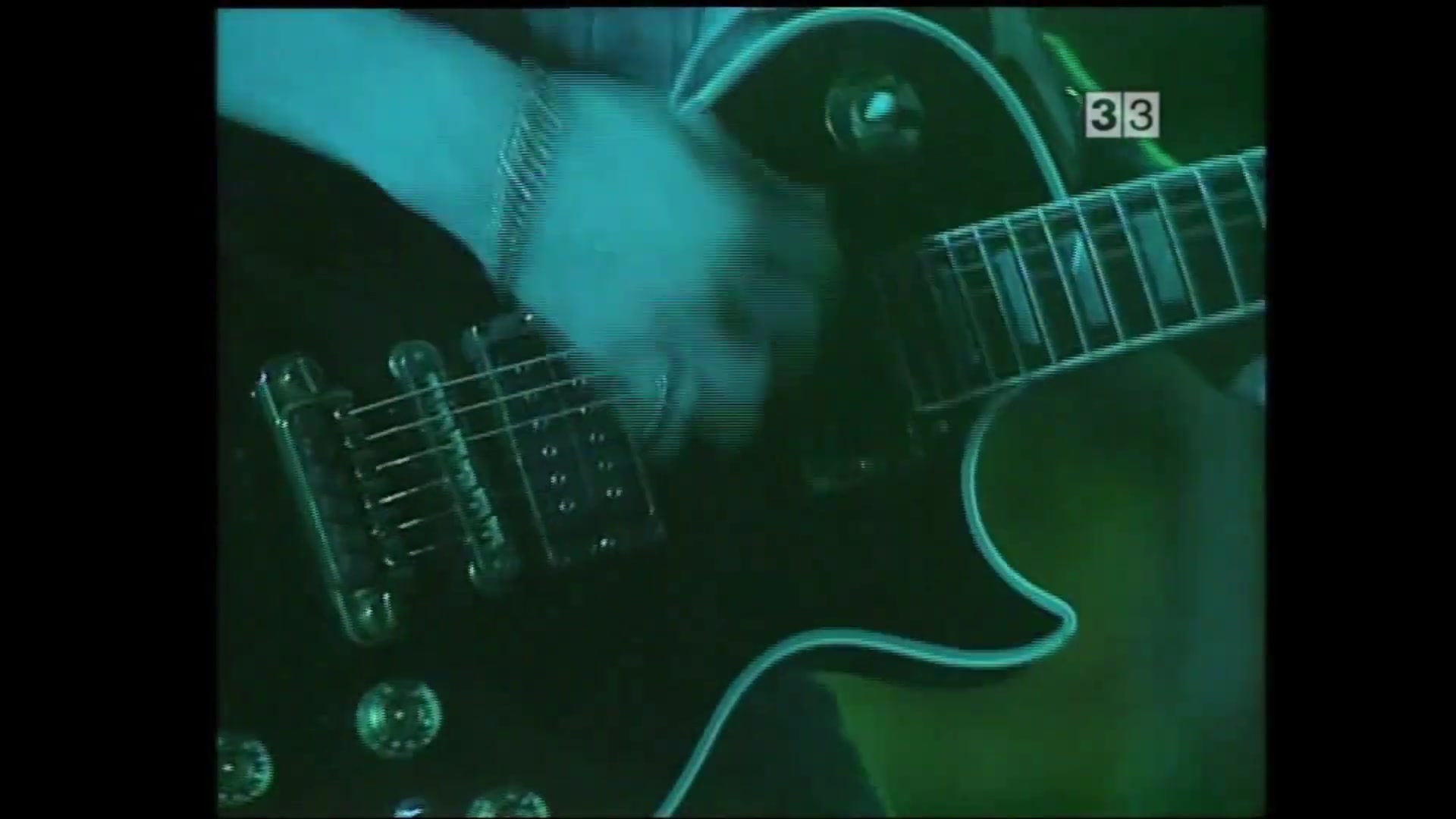
The definitive answer came completely by chance a couple of months ago. I’m watching The Smiths’ 1985 Barcelona gig on YouTube5: Johnny’s main guitar at the time was the Black Les Paul Custom.
During Barbarism Begins at Home, I spot a close-up of the bridge pickup: I literally jump off the sofa to look closely. The twelve adjustable hex polepieces are unmistakable: it is a DiMarzio Super Distortion.
Except… it probably isn’t.
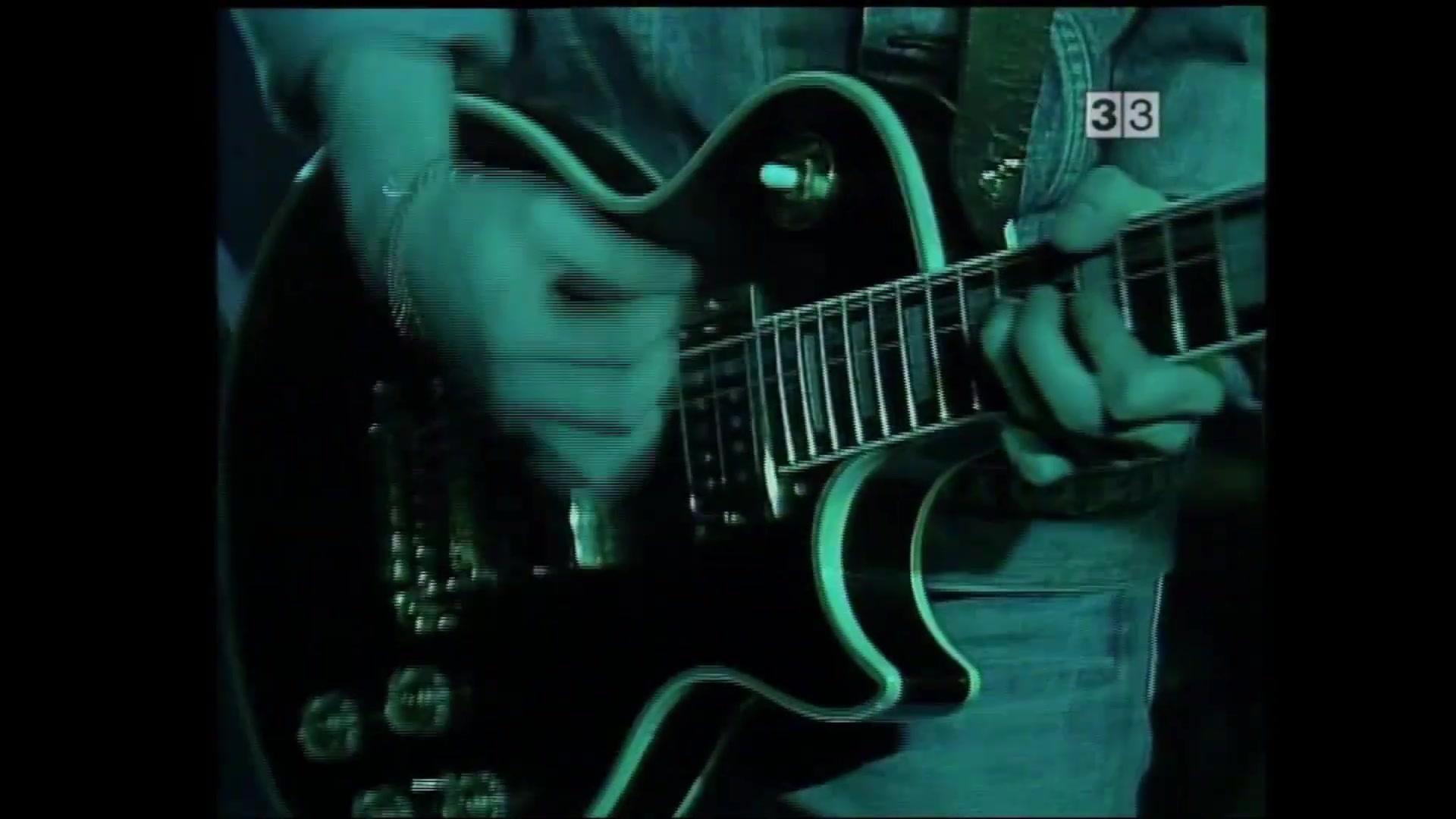
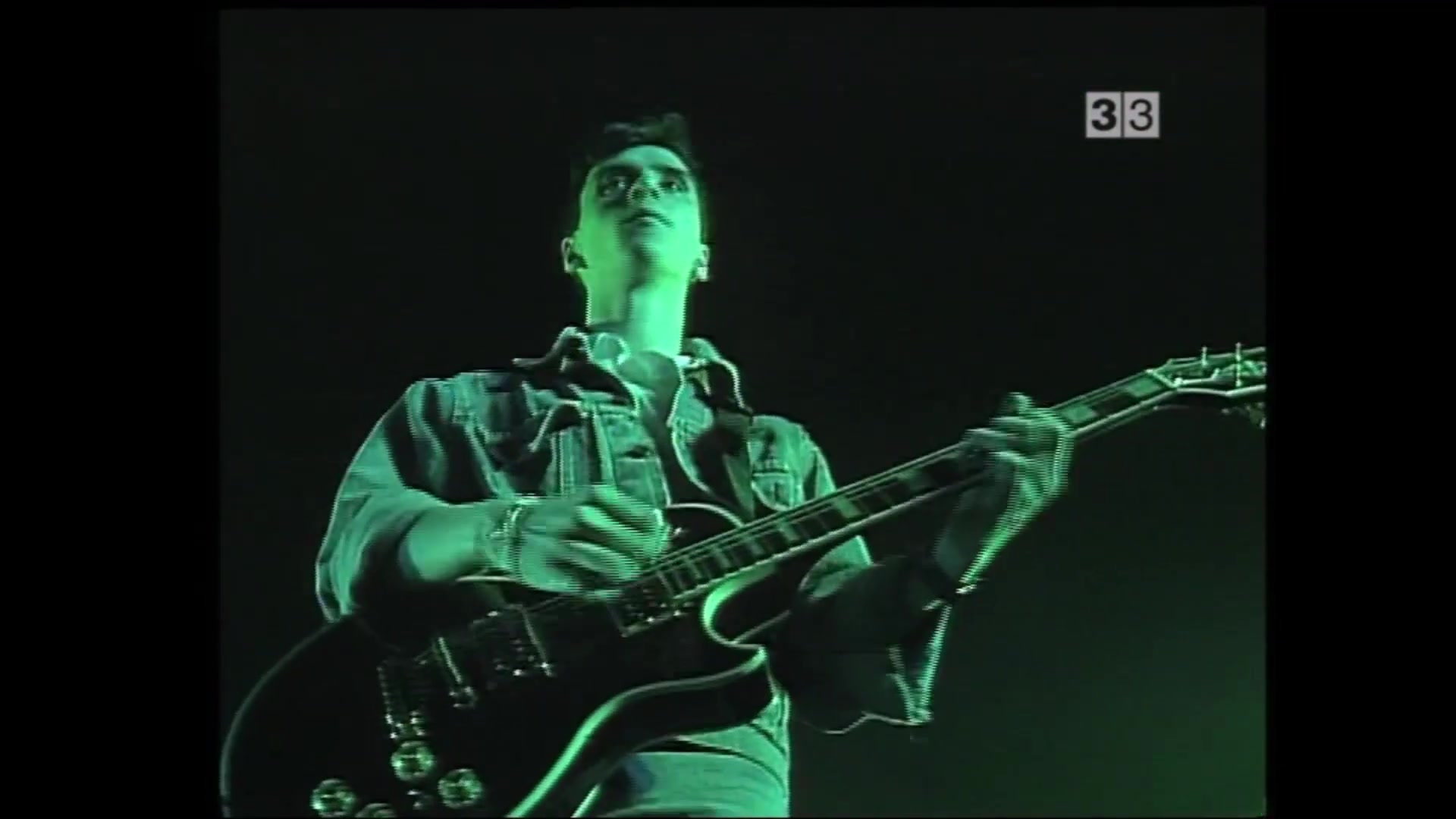
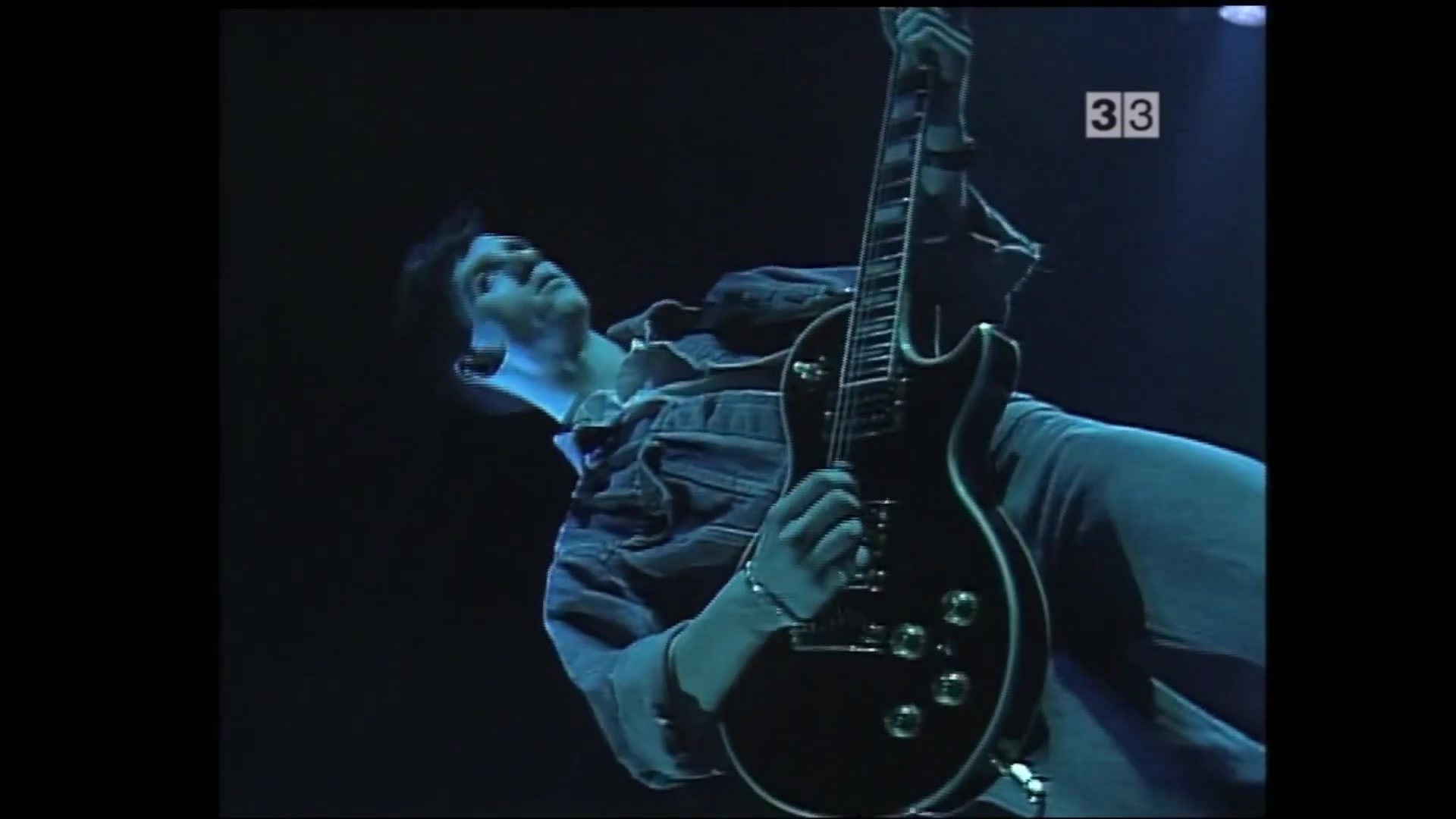
Johnny’s black Custom was fitted with a coil-split feature6, operated via the distinctive mini toggle switch that makes this guitar instantly recognizable. Normally, you need pickups with four-conductor wiring to make coil-splitting possible.
Here’s the issue: in the 1970s and ’80s, the Super Distortion only came with standard two-conductor wiring. That meant coil-splitting wasn’t straightforward unless a tech went through the hassle of dismantling the pickup and replacing the wire with a four-conductor. Definitely possible, but hardly worth the effort.
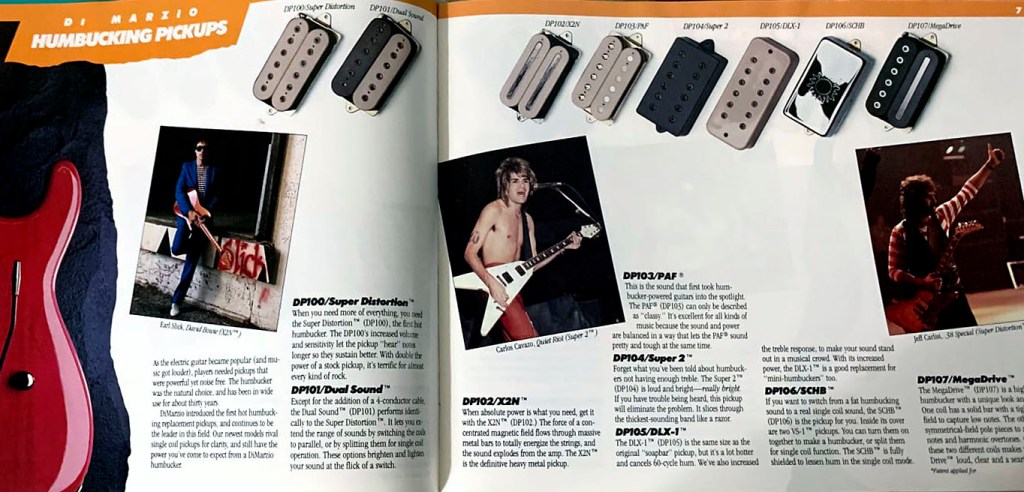
Why bother, when DiMarzio already offered the Dual Sound? It was identical to the Super Distortion but shipped with four-conductor wiring. Early models had three-conductor wiring, which was a bit less flexible but still allowed coil-splitting.7
They even came with its own mini-toggle switch. Starting to sound familiar?
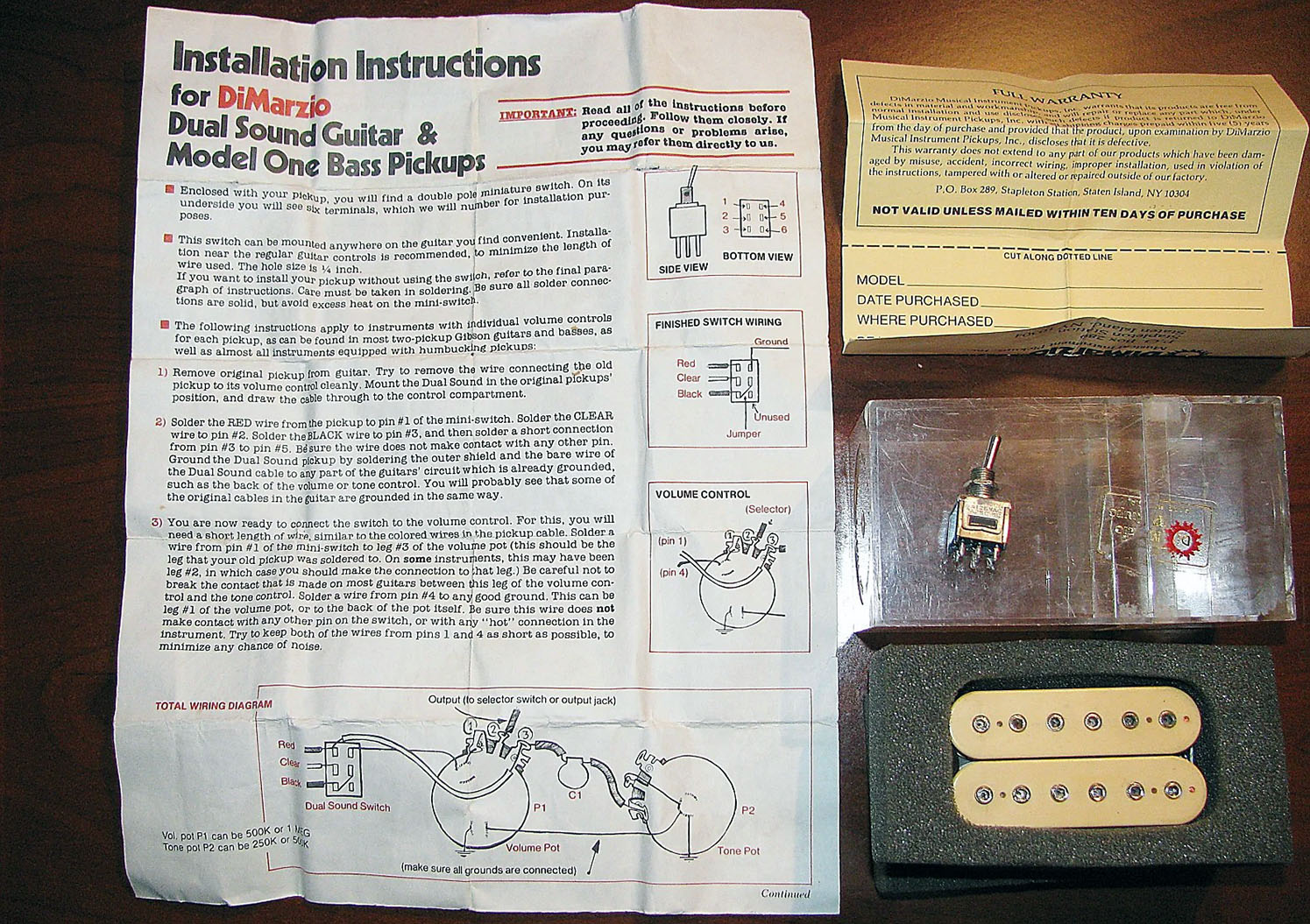
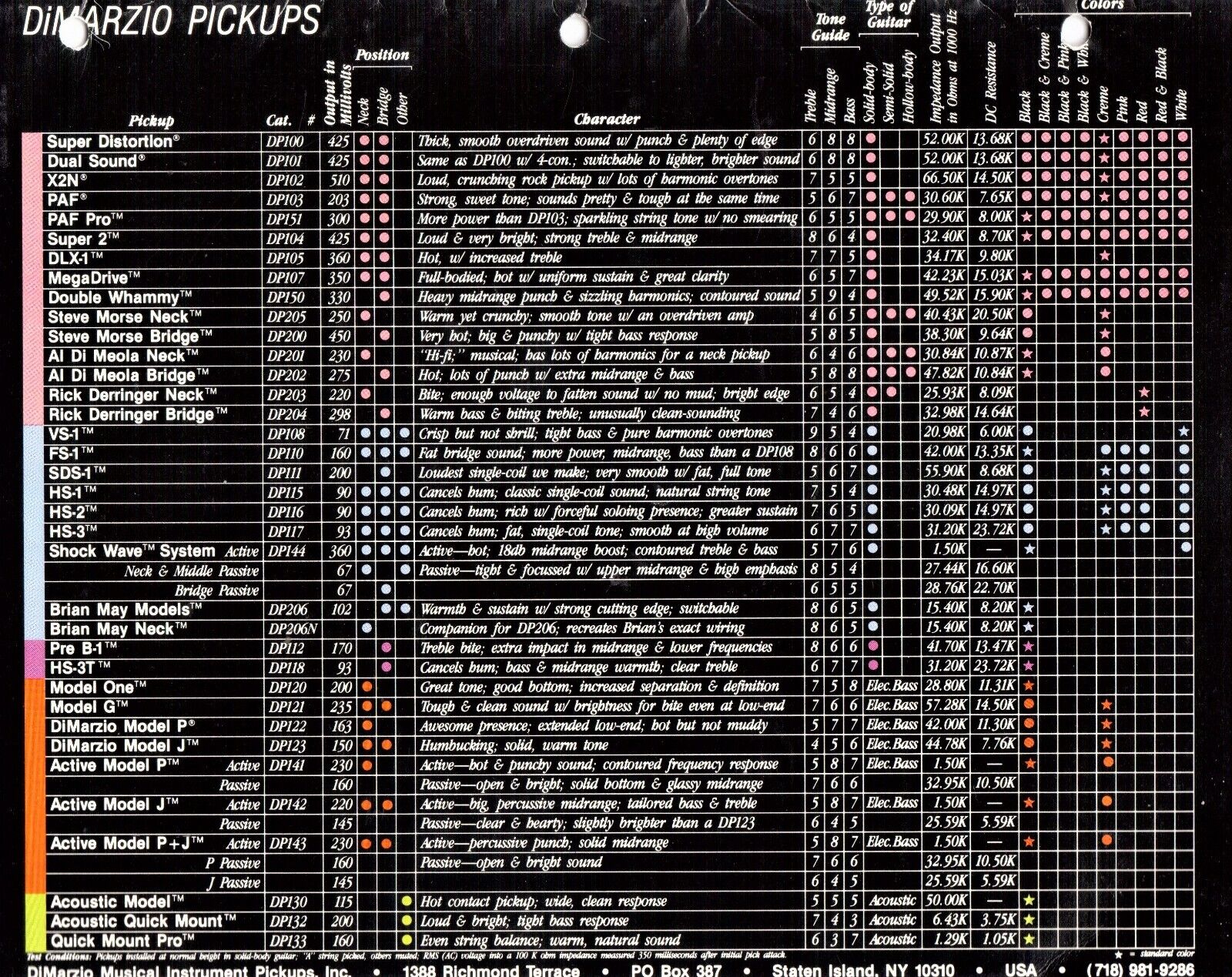
The specs of the Super Distortion (DP100) and the Dual Sound (DP101) are identical, as confirmed in several DiMarzio catalogs from the era, including the 1987 edition shown above.
So we can safely say that the bridge pickup in Johnny’s Black Custom was a DiMarzio Dual Sound. Mystery solved!
By the way, a regular Super Distortion was installed in Johnny’s Gibson Flying V, which Noel played during the Monnow Valley recording sessions in 1994 and was allegedly used on the version of Slide Away that ended up on Definitely Maybe.
For my replica, I decided to install a black DP100 Super Distortion. Today, there’s virtually no difference between a DP100 and a DP101, as both come with four-conductor wiring. The pickup itself is a recent 50th Anniversary model, but I used hex pole pieces from an original ’80s DP100 to give it a more authentic look.

And what about the neck pickup? This is where things get more speculative.
From an Oasis perspective, it’s not particularly relevant, since Noel almost always favored the bridge pickup. Johnny, however, did use the neck pickup, so what could it have been? From the photos, it clearly isn’t another Dual Sound: it looks like a standard humbucker, which makes precise identification tricky.
Could it have been the original Gibson T-Top? Possibly – but with its standard two-conductor wiring, achieving a coil split would have been tricky, as explained above.
My best guess is that it’s another DiMarzio, which would have been the most obvious choice. The Super Distortion/Dual Sound was often paired with a PAF-style model in the neck position: the likely candidate is a DiMarzio PAF (DP103).
Other DiMarzio humbuckers available in the mid-’80s either look noticeably different or aren’t suited for a neck position.
For my replica, I didn’t want a regular PAF-type humbucker in the neck. I wanted something stronger, with a different voicing that could keep up alongside a Super Distortion.
I settled on a DiMarzio Air Norton8 (DP193): it was not available in 1985, but in my opinion it is now a better match for the Super Distortion. It still retains PAF features, but it is thicker and more aggressive – and it sounds noticeably fuller when coil-split.
Johnny often played the Les Paul with the coil tap engaged and the main toggle switch in the middle position, putting both pickups in parallel in single-coil mode. Add an ’80s-style chorus (like the legendary Boss CE-2) in front of a clean amp, and you instantly get that classic Marr tone,9 as heard in the Barcelona 1985 gig.
Flip the mini-toggle back to humbucker mode, select the bridge pickup, dial in a crunchy, fat tone, and you’re suddenly in Cigarettes & Alcohol territory – with the very same guitar! I’d never tried a Super Distortion before, but now I understand why it has remained so popular for half a century!

- This was thanks in part to the Marr’s Guitars book, which finally revealed the correct year, the serial number and also featured lots of excellent pictures by Pat Graham. ↩︎
- Total Guitar – May 2000 ↩︎
- That Pedal Show ↩︎
- Oasis: A Year On The Road – Paul Slattery, 2008 ↩︎
- https://youtu.be/4h_kVEfU-os&t=90 ↩︎
- Simply put, coil split means you take a humbucker (two coils) and switch it so only one coil is active, giving you a single-coil pickup sound. It’s basically like “cutting the pickup in half”. ↩︎
- https://guitarnuts2.proboards.com/thread/9317/wire-colours-1978-dimarzio-sound ↩︎
- https://www.dimarzio.com/pickups/vintage-paf-output/air-norton?v=23347 ↩︎
- Rate just below noon and depth around three o’ clock is the perfect “Johnny Marr” setting on a Boss CE-2. Take notes! ↩︎
 The Chief's Guitars - Noel Gallagher's guitars: a complete guide - Oasis and NGHFB
One thought on “The pickups in Noel’s Les Paul Custom: mystery solved?”