
This article serves as a companion piece (or appendix) to the one analyzing Noel’s 2025 pedalboard.
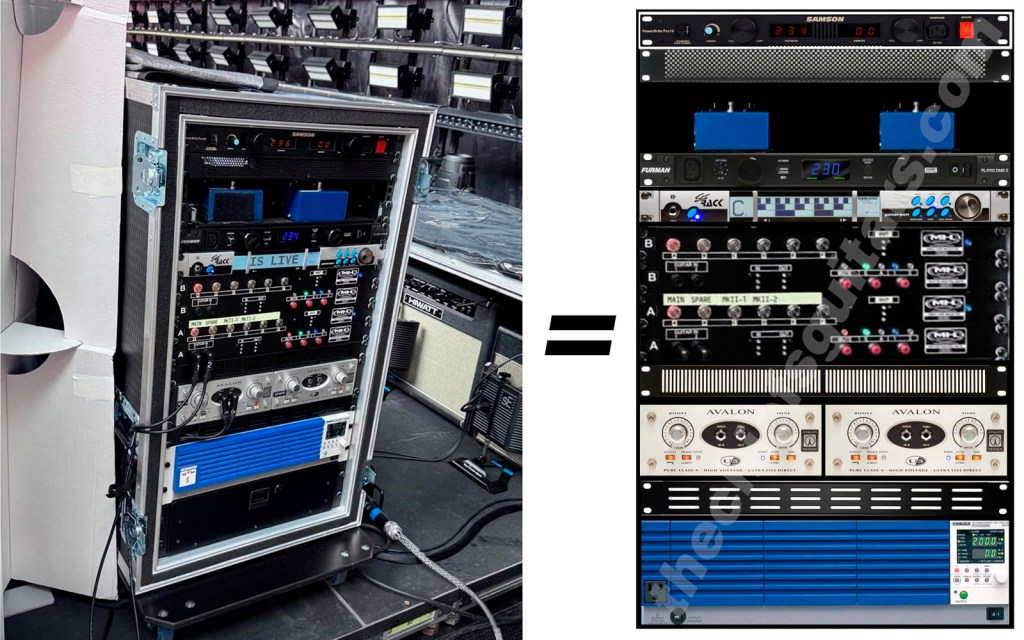
A couple of weeks ago, a reader (thanks Jaiden!) sent me a photo of Noel’s rack unit. For those unfamiliar with this kind of stuff, a rack unit is essentially a portable road case that holds multiple pieces of gear (like power conditioners, signal splitters, preamps, and effects). Basically, it’s a sort of middle link between the pedalboard and the mixing desk.
It took a bit of work, but here you’ll find a detailed analysis of what each component is and what it does. Probably not quite as thrilling as the pedalboard itself, but still a very interesting read for the gear geeks out there.
Keep reading for the full breakdown of Noel’s Oasis Live ’25 rack!
DISCLAIMER
This is a fansite. It is not affiliated with Noel Gallagher, his management or his record label.
For informational and non-commercial use only. Please do NOT publish this content elsewhere.
If you share or use this information, please provide proper credit and link to the website.
I appreciate your respect for the years of dedicated, freely available research!
Visit the “Info & About” page for contact details and more.
Thanks!
Judging from old photos on my hard drive, Noel’s 2025 live rack appears to be almost identical to the one he used in the High Flying Birds era: the major changes are upgraded amp input/selector units – expanded to handle a more complex setup – and a strobo tuner. Every component except the tuner has a backup unit, just in case.
During gigs, Noel’s guitar tech runs the rack, switching between guitars and/or amps when needed. For example, on the last NGHFB tour, the tech would swap from the Hiwatts to a Fender Vibrolux amp for songs like Open The Door, See What You Find and The Mighty Quinn (both played with one of the Epiphone USA Casinos).
The rack sits on stage, right between the Hiwatts which act as stage props and the real amps: two Hiwatt Custom 50s and two Marshall Studio Vintage Mk2s (more about those in the reunion gear analysis). In the photo, you can spot Pep Guardiola’s cardboard cutout leaning against the left side of the rack!
Anyways, here’s a rough diagram of the full rack setup:

1 – Samson PowerBrite PRO10
This element is a power conditioner – essentially a rig power hub: it delivers clean and stable power to all components in the rack system, and it protects from power spikes, noise, etc. The two displays show voltage and current at any time.

2 – SIB Fatdrive (x2)
The Fatdrive is a tube-based overdrive/preamp pedal; SIB also produced the Echodrive, one of the staples of Noel’s pedalboard. There are actually two Fatdrives here: one as the main unit and the other as a spare.
This pedal, which I originally mistook for an Echodrive, had me puzzling for quite a while, until I remembered an email from reader Kazu in Japan that I received last year: “Noel’s acoustic sound is the guitar into a Fatdrive with gain set to zero […] and a DI“. That’s it! The DI is the Avalon U5 preamp – #9 in the list.
So, Noel shapes the sound from his acoustic (adjusting bass, mids, and treble) with this rare pedal before sending it into a DI box. Thanks Kazu!

3 – Furman PL-PRO DMC-E
This is another power conditioner, most likely serving as a backup to the Samson (#1 in the list) – or perhaps it’s the other way around.

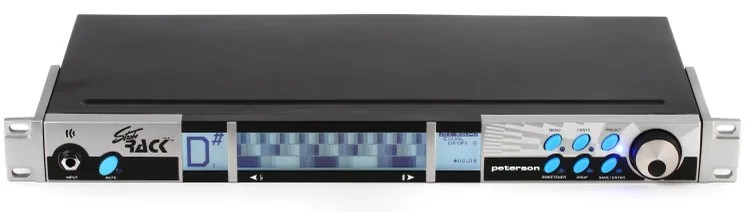
4 – Peterson StroboRack
This is a rack-mounted digital tuner: being a strobo tuner, it means that a spinning pattern on the screen is used to show how close a note is to pitch. When the pattern appears stationary, the note is perfectly in tune.
When not in use, the display scrolls a custom message: in the photo, it reads “IS LIVE” which is probably part of “OASIS LIVE ’25”.
5 – Mike Hill amp selector unit
A backup to #7 – see below.
6 – Mike Hill input selector unit
A backup to #8 – see below.
7 – Mike Hill amp selector unit
This is a custom unit built by Mike Hill Services. It is used to distribute the electric guitar signal to the various amps (up to 6). The switches activate the corresponding amp: on the label we can read “MAIN” / “SPARE”, which are the two Hiwatt Custom 50 2×12, and “MKII-I” / “MKII-II”, which refer to the 20w Marshall Studio Vintage Mk2s (main and backup). Check out the picture below.

8 – Mike Hill input selector unit
This is another custom unit from Mike Hill services.
To the left, it has inputs for two different electric guitars; the acoustic input could/should be on the back.
The six leds (3 IN, 3 OUT) show which inputs are plugged in and which outputs are selected: the inputs are the two electric guitars and the acoustic.
The red switches, which say “MUTE”, “E A”, and “1 2”, are used to select the output: “MUTE” is of course no output, “E A” allows to switch between electric and acoustic, and “1 2” switches between the two electric guitars.

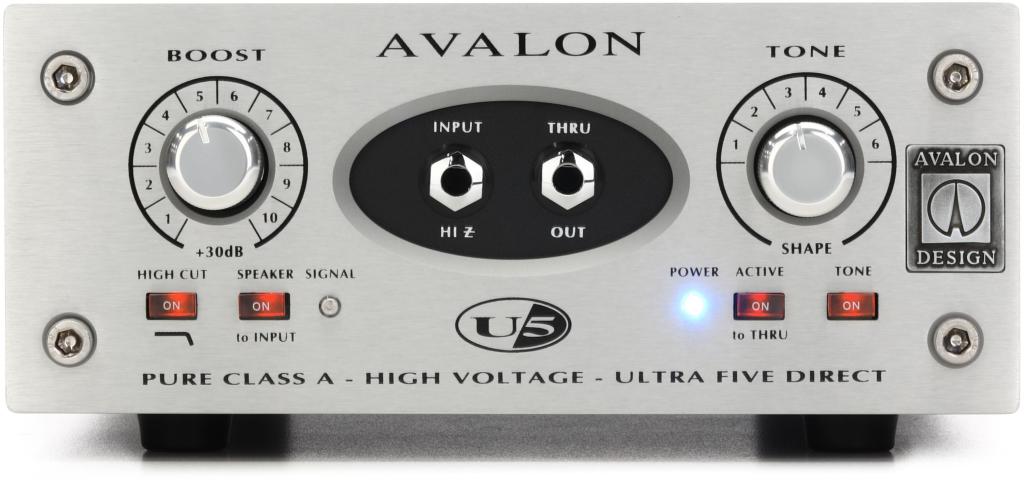
9 – Avalon U5 (x2)
The two U5 units (main and backup) are used as preamps/DI boxes for the acoustic guitar signal; a DI boosts and converts the instrument’s signal and converts it so that it can go directly to the mixing desk and then to the PA system. This is where the acoustic guitar signal goes after passing through the Fatdrive. The electric guitar signal does not pass through this unit, of course.
The U5 has two knobs: BOOST – which should be self-explanatory, and TONE – which Noel seems to have set to neutral.
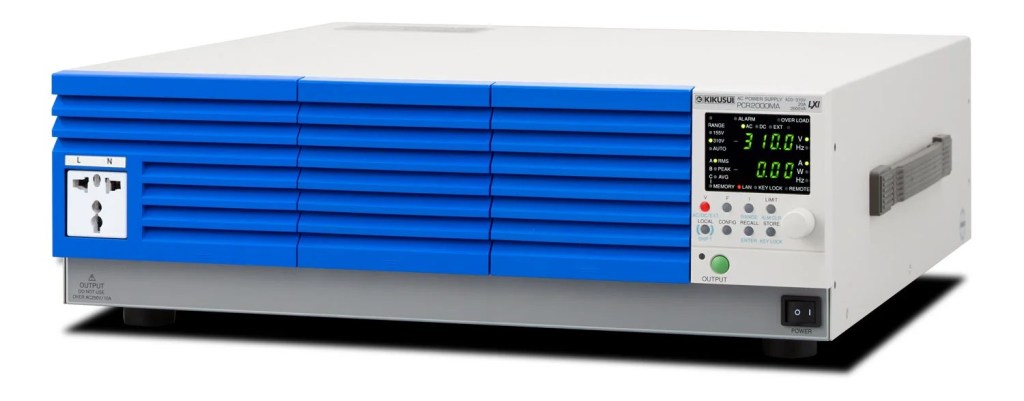
10 – Kikusui PCR2000MA
Identifying this one took a long time! It’s pretty uninteresting: the website describes it as “a small-size AC power supply with the ease of a variable auto transformer or an automatic voltage regulator“. It is probably used to provide stable supply regardless of varying input voltages (e.g. 110V/60Hz in USA or 230V/50Hz in Europe and Asia). Nothing seems to be connected to the output, so it might be used only during the USA leg of the tour because of the different voltage in North America.
So, to recap, here are the signal chains for both electric and acoustic guitars:
ELECTRIC GUITAR ->
                -> MH Input Selector ("E" selected) ->
                -> StroboRack tuner? ->
                -> PEDALBOARD ->
                -> MH Amp selector ->
                -> AMPS
ACOUSTIC GUITAR ->
                -> MH Input Selector ("A" selected) ->
                -> StroboRack tuner? ->
                -> FatDrive (drive knob set to zero) ->
                -> Avalon U5 ->
                -> mixing desk
That’s it!
Hope you enjoyed this one! If you did (and if you missed them) here are some related articles you might like too:
First gig/reunion gear analysis (guitars, amp, etc): link!
Noel Gallagher’s reunion pedalboard (full analysis): link!
Bonehead’s reunion pedalboard (full analysis): link!
DISCLAIMER
This is a fansite. It is not affiliated with Noel Gallagher, his management or his record label.
For informational and non-commercial use only. Please do NOT publish this content elsewhere.
If you share or use this information, please provide proper credit and link to the website.
I appreciate your respect for the years of dedicated, freely available research!
Visit the “Info & About” page for contact details and more.
Thanks!
 The Chief's Guitars - Noel Gallagher's guitars: a complete guide - Oasis and NGHFB
Enjoying these posts! Any plans to cover Andy’s gear?
LikeLike
The Kikusui unit is some kind of standard when you travel worlwide; I remember it in AC/DC and Brian May rig rundown with one or two techs making fun of US “silly power” (120 V)
LikeLike
Posts like these are pure gold for us Oasis / Noel gear heads! I do own an Avalon U5 Preamp as well as an SIB Fatdrive (as a matter of fact the exact same one as in the picture above, bought it from Found Sound through Reverb a few weeks ago) – I’m almost a 100% sure that the assumption that the “Drive” knob on the Fatdrive set to Zero cannot work out – the Fatdrive does not output any signal when the Drive is set to Zero. I tried multiple different settings with my Fatdrive and U5 combo, what really seems to work well is when you set the Drive to around half, and the Volume to 3/4, thats where all starts to get alive! I do believe that the Bright switch must also be engaged with Noel’s acoustics, otherwise these Jumbo Guitars can sound a bit too dark – but thats just an assumption from my end.
LikeLike